
Inside the 2025 AHA PALS Guidelines: What’s New for Pediatric Emergency Care
Pediatric emergencies demand a different level of precision, speed, and clinical intuition. Children are not “small adults”; their physiology, deterioration patterns, and emergency presentations require a unique approach to resuscitation. That’s why the pediatric-specific updates found in the 2025 American Heart Association (AHA) CPR & ECC Guidelines are so important.
We’re exploring the major changes to Pediatric Advanced Life Support (PALS) guidance that shape how healthcare professionals respond to critically ill infants, children, and adolescents. And importantly, ACLS Academy is already teaching the full, official 2025 PALS Guidelines, not the interim updates. Every instructor is certified, and every course has been revised to reflect the newest science.
Here's what students can expect in the updated course.
The Most Up-to-Date Science
The AHA updates its guidelines every five years to ensure lifesaving care reflects the strongest, most current scientific evidence available. For pediatric populations, the 2025 updates draw heavily from:
New studies in pediatric airway management
Research on early recognition of respiratory failure and shock
Global resuscitation consensus from pediatric experts
Large-scale survival and neurological outcome data
Human-factors and team-based performance findings
Expanded evidence on pediatric post–cardiac arrest care
Because pediatric arrests often begin with respiratory compromise rather than primary cardiac causes, this year’s updates sharpen early assessment, airway interventions, and shock management recommendations.
What’s New in the 2025 PALS Guidelines
The 2025 PALS updates include improvements across all major areas of pediatric emergency care: algorithms, airway management, medication pathways, team dynamics, and post-arrest care. Below are the most significant changes clinicians need to know.
1. Updated Pediatric Cardiac Arrest Algorithms
The new guidelines streamline the cardiac arrest pathway to reduce hesitation and improve flow. Key updates include:
Stronger emphasis on minimizing interruptions in compressions
Clearer sequencing for shock delivery
Updated recommendations for medication timing
Simplified cues to help providers keep treatment moving efficiently
These refinements reduce cognitive load during high-stress events and support more consistent outcomes.
2. Enhanced Airway & Respiratory Management
Airway and ventilation are among the most important pediatric-centered updates. The 2025 guidelines now include:
Clearer indications for advanced airway placement
Updated ventilation rates for each age group
Guidance on preventing hyperventilation—still one of the most common errors
Simplified instructions for bag-mask ventilation for both single and multi-rescuer teams
These updates help ensure that oxygenation and ventilation are optimized for children’s unique physiology.
3. Stronger Guidance for Shock Recognition & Management
The 2025 guidelines elevate the importance of recognizing pediatric shock early—and differentiating the type of shock quickly. Updates include:
Clearer cues for compensated vs. decompensated shock
Revised approaches to fluids and vasoactive medications
Evidence-backed treatment recommendations for hypovolemic, cardiogenic, and distributive shock
Earlier recognition and targeted treatment can significantly improve survival rates.
4. Updated Bradycardia & Tachycardia Algorithms
This round of updates clarifies:
When a rhythm is “unstable” and requires immediate intervention
Indications for synchronized cardioversion
Revised medication guidance
Age-specific considerations for heart rate thresholds
These improvements simplify decision-making and help pediatric providers confidently choose the appropriate pathway.
5. New Emphasis on Human Factors in Pediatric Resuscitation
Just like in the ACLS and BLS 2025 updates, team dynamics and communication skills receive enhanced attention. The PALS guidelines now emphasize:
Closed-loop communication
Early role assignment
Maintaining an organized team flow
Behavior and communication strategies that reduce errors in stressful pediatric situations
These human-factor improvements can significantly impact real-world performance in EDs, PICUs, and prehospital settings.
6. Evidence-Based Pediatric Post–Cardiac Arrest Care
The guidelines strengthen post-arrest recommendations, including:
Temperature management strategies
Personalized perfusion and oxygenation targets
Neurologic status monitoring
Integration with PICU stabilization pathways
This reflects the growing body of evidence showing that outcomes are shaped not just by the initial resuscitation, but by what happens afterward.
The PALS Science Summary Table & Where to Access the Full Guidelines
The AHA’s PALS Science Summary Table is one of the most important resources for pediatric clinicians. This quick-reference tool includes:
Major changes from the 2020 guidelines
Evidence levels supporting each update
Updated dosing suggestions
New algorithm logic
Clinical rationale for each shift
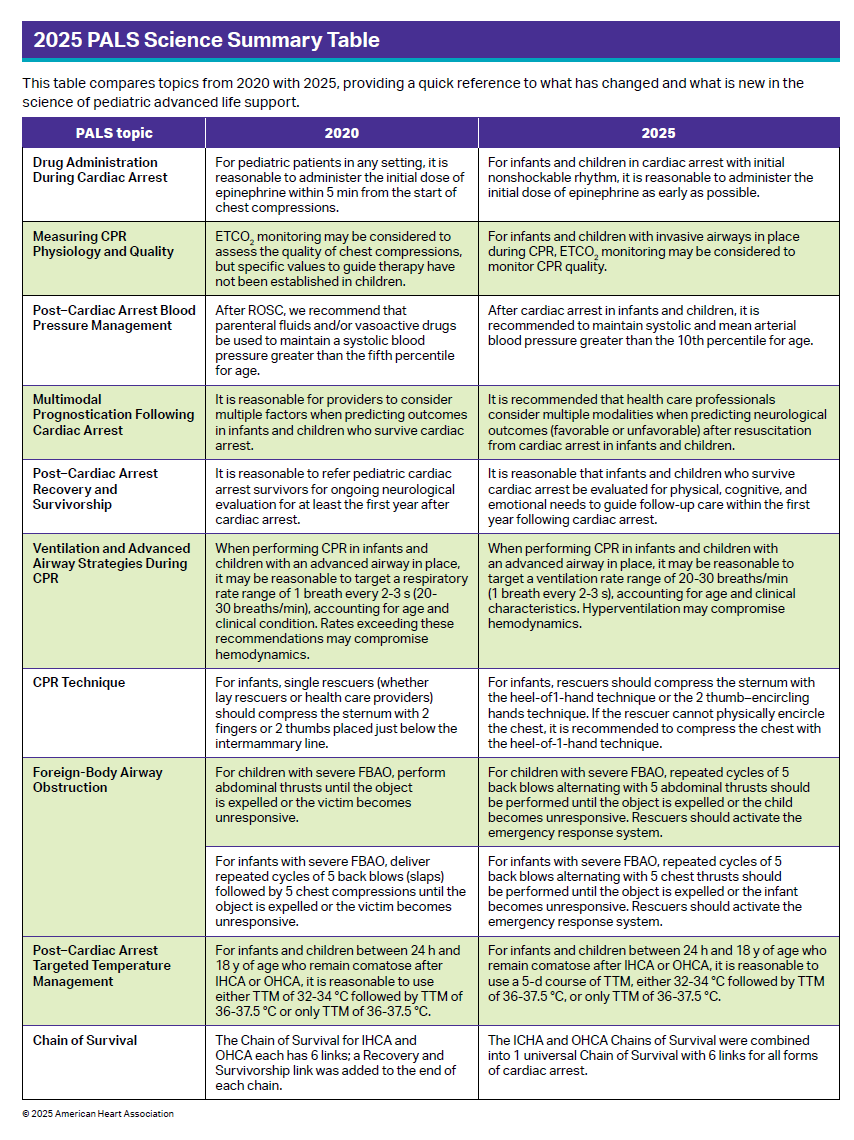
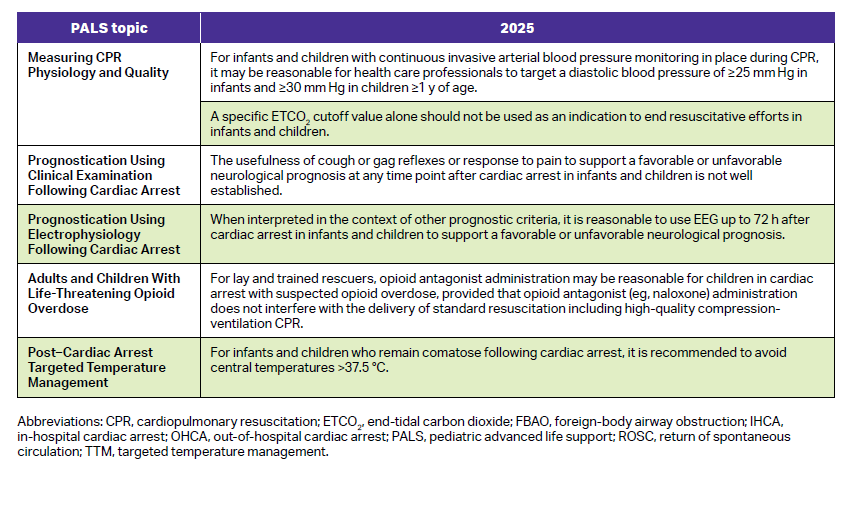
We strongly encourage providers to keep the PALS summary table accessible during pediatric simulations, clinical shifts, teaching sessions, and onboarding.
The table, along with the full 2025 CPR & ECC Guidelines, algorithms, evidence reviews, and Abstracts, is available in the PALS section of the AHA’s official 2025 Guidelines for CPR & ECC release.
ACLS Academy Has Fully Transitioned to the 2025 PALS Guidelines: What Students Can Expect
ACLS Academy made an immediate commitment to teaching the full 2025 PALS Guidelines, skipping the interim transition period entirely. This means:
Every instructor is certified on the updated science
All materials, manuals, and course videos reflect the final guidelines
Pediatric manikins and monitoring devices are reprogrammed
Megacode scenarios use the revised algorithms
Skills testing aligns with the newest evidence-based standards
In the classroom, students can expect:
Hands-on practice with the updated pediatric airway strategies
Realistic simulations of shock, respiratory failure, and cardiac arrest
Enhanced rhythm recognition practice
Updated medication and defibrillation pathways
Expanded team communication and leadership drills
Scenarios designed for infants, children, and adolescents
Whether you’re a seasoned provider or renewing your certification, you’ll leave class confident, competent, and fully aligned with national best practices.
Better Pediatric Science. Better Outcomes. Better Training.
Pediatric emergencies require fast thinking, clear pathways, and evidence-based action. The 2025 PALS Guidelines deliver stronger science, more intuitive algorithms, and improved strategies for airway management, shock recognition, and team coordination.
With ACLS Academy already teaching the updated standards, you can be confident your training reflects the most current and effective approach to pediatric emergency care.
Ready to update your PALS certification? Sign up for a PALS class today.
ACLS Academy is ready for you.