
2025 BLS Guidelines Are Here — And ACLS Academy Is Leading the Transition
Basic Life Support (BLS) is the cornerstone of every successful resuscitation. Performed by a healthcare professional, BLS sets the stage for everything that follows: early recognition, early CPR, early defibrillation, and early advanced interventions. With the release of the 2025 AHA CPR & ECC Guidelines, the American Heart Association has refined and strengthened the science behind these essential skills.
In this month’s blog series, ACLS Academy is breaking down the 2025 updates course by course. Today, we’re focusing on BLS, what’s new, why the guidelines were updated, how these changes improve real-world outcomes, and what you can expect when taking a newly updated BLS course with ACLS Academy. And most importantly: ACLS Academy is already teaching the 2025 BLS Guidelines right now, giving students immediate access to the latest science and best practices.
Why the 2025 BLS Guidelines Were Updated
Every five years, the AHA updates its lifesaving guidelines to reflect the strongest and most current evidence in resuscitation. The 2025 updates are the result of:
International scientific collaboration
Ongoing analysis of global resuscitation registry data
Human factors and team performance research
Clinical trials studying CPR mechanics and outcomes
Comparative studies of shock delivery, ventilation, and assessment techniques
The ultimate purpose is to ensure that rescuers, whether on the hospital floor or in the community, are equipped with techniques proven to increase survival and improve neurological outcomes.
Major Changes in the 2025 BLS Guidelines
The 2025 BLS updates strengthen recognition of cardiac arrest, emphasize high-quality CPR, simplify AED guidance, and refine both ventilation and teamwork components. Below are the most notable changes clinicians and rescuers should know.
1. A Stronger Focus on High-Quality Compressions
High-quality chest compressions remain the foundation of effective cardiac arrest response, but the 2025 guidelines sharpen the specifics:
Reinforced messaging on compression depth and rate
Clearer guidance on maintaining full chest recoil
Updates emphasizing the avoidance of over-compression
Strong focus on maintaining consistency and minimizing variability
This section underscores that even slight deviations in compression quality can significantly impact survival rates.
2. Faster and More Accurate Cardiac Arrest Recognition
The AHA has refined the steps rescuers should take to rapidly identify:
Lack of responsiveness
Abnormal breathing
Agonal breathing patterns
Streamlined recognition cues help rescuers act more quickly and avoid delays in initiating CPR.
3. Updated Ventilation Recommendations
Ventilations play a critical role in BLS, especially for pediatric patients. The 2025 updates include:
Revised guidance on rescue breath timing
Age-specific ventilation rate clarifications
Emphasis on avoiding hyperventilation, which remains a common pitfall
Simplified steps to make both clinical and layperson rescuers more confident
These refinements ensure that breaths are delivered safely and effectively.
4. Early AED Use and Simplified Defibrillation Steps
The AED guidance has been simplified across all age groups:
Clearer instructions for single-rescuer vs. multi-rescuer scenarios
More streamlined recommendations for shock delivery
Consistency across adult, pediatric, and infant guidance where clinically appropriate
This simplification reduces confusion and supports faster defibrillation—one of the strongest predictors of survival.
5. Updated Adult, Child, and Infant Algorithms
Each population group—adult, child, and infant—has updated flow diagrams that:
Align more clearly with one another
Reduce unnecessary complexity
Improve recall under stress
Support smoother teamwork during multi-rescuer CPR
These new visuals reflect the AHA’s goal of creating intuitive, easy-to-follow steps for all rescuers.
6. Human Factors in BLS
The AHA continues to highlight the importance of teamwork and communication. The 2025 updates include:
More emphasis on role assignment
Stronger recommendations for closed-loop communication
Reinforced messaging for two-rescuer CPR
Consistency with ACLS human-factor updates
These refinements help rescuers perform more cohesively and confidently during real emergencies.
The BLS Science Summary Table: Your Essential Quick Reference
The 2025 BLS guidelines include an incredibly valuable resource: the BLS Science Summary Table. This summary provides:
A quick comparison of guideline changes vs. the 2020 edition
Evidence levels supporting each update
Condensed treatment recommendations
Clear rationales for major shifts
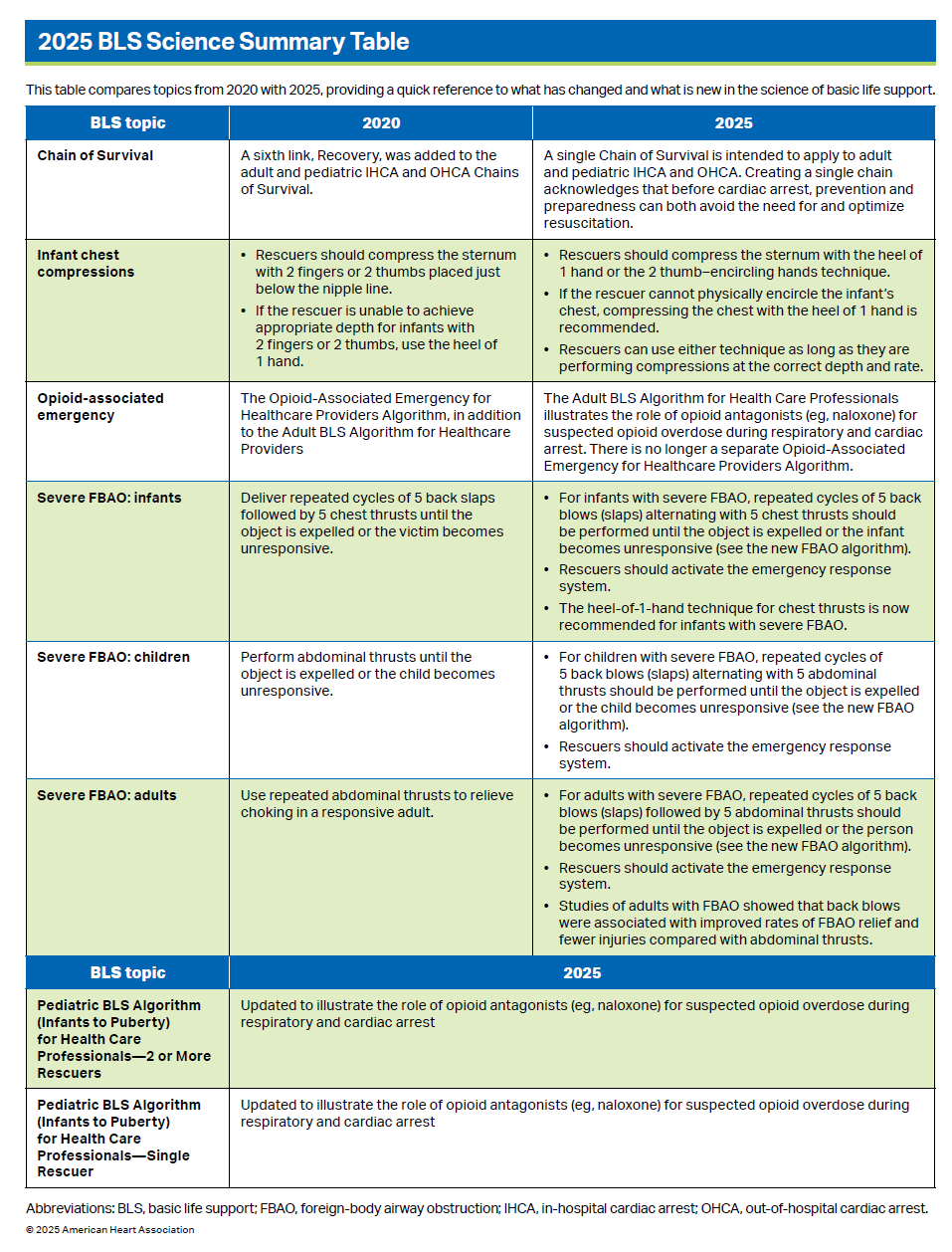
For clinical teams, educators, and frequent responders, this table should be considered a must-have reference. It helps rescuers stay aligned with the newest evidence while offering a rapid way to review updates before training, rounding, or simulation.
You’ll find the Science Summary Table in the BLS section of the AHA’s full guideline materials within the CPR & ECC 2025 update release.
ACLS Academy Is Fully Transitioned to the 2025 BLS Guidelines
ACLS Academy made an early and strategic decision to teach exclusively to the official 2025 guidelines—not the interim material. This means:
Instructors are fully retrained and certified
All educational materials reflect the newest science
Testing and skills checks are aligned with updated BLS standards
Manikin programming supports new compression and ventilation metrics
Students benefit by receiving the most accurate and up-to-date instruction available—without needing to relearn newer content later.
What Students Can Expect in the Updated BLS Course
Students attending BLS training at ACLS Academy can expect:
Hands-on practice using updated CPR and ventilation steps
Updated AED scenarios with simplified timing and instructions
Improved two-rescuer practice aligned with human factors updates
Streamlined infant, child, and adult algorithms
Guidance on recognizing agonal breathing and initiating CPR faster
Supportive instruction from certified healthcare professionals
Whether you are a renewing healthcare provider or a first-time student, this course ensures you’re performing the most current, evidence-based skills.
For those who want to explore the complete set of evidence updates, systematic reviews, algorithms, and BLS Science Summary tables, you can find them in the AHA’s 2025 Guidelines for CPR & ECC available on the AHA’s Science News platform.
Stronger Science, Better Outcomes, and Training You Can Trust
The 2025 AHA BLS Guidelines strengthen the foundation of lifesaving care through clearer recognition steps, improved compression and ventilation recommendations, simplified AED guidance, and enhanced teamwork strategies.
With ACLS Academy already teaching the new standards, students can enroll with confidence knowing they’re learning directly from the most current and reliable source of lifesaving education.
Ready to update your BLS certification with the 2025 guidelines?
ACLS Academy is ready for you. Sign up for a BLS class.