
We Are Teaching the New 2025 AHA ACLS Guidelines
When the American Heart Association (AHA) released the 2025 CPR & Emergency Cardiovascular Care (ECC) Guidelines this fall, it marked the beginning of a new era in resuscitation science. These updates—issued roughly every five years—reflect the latest evidence on how to improve survival from cardiac arrest and streamline clinical decision-making. For healthcare providers who respond to cardiac emergencies, the Advanced Cardiovascular Life Support (ACLS) updates are particularly significant.
As part of our December blog series, ACLS Academy is breaking down the 2025 changes course by course, starting with ACLS. In this deep dive, we’ll review what’s new, why these updates matter, how the guidelines were formed, and how ACLS Academy has already fully integrated the new standards into every training session.
To explore the official AHA Guidelines, Abstracts, and all course-relevant materials, you can access the complete resource library here on the AHA’s Science News site.
Why the AHA Updated the ACLS Guidelines
The AHA updates its guidelines to reflect the latest and strongest evidence in cardiovascular science. These reviews include:
Global scientific consensus from resuscitation councils
Data from the AHA’s Get With The Guidelines–Resuscitation Registry
Randomized controlled trials and large observational studies
Systematic reviews and meta-analyses
Human factors research
Post-resuscitation survival and neurologic outcome data
The goal is simple: better survival, better neurological outcomes, and clearer clinical decision pathways.
The 2025 ACLS updates continue the AHA’s ongoing effort to make resuscitation easier to perform, easier to teach, and more consistent across healthcare systems.
Major Changes in the 2025 ACLS Guidelines
The 2025 ACLS updates include refinements that clarify algorithms, streamline best practices, and sharpen the focus on high-quality CPR and team performance. Below is a high-level breakdown of the most notable changes practitioners will see.
1. Adult Cardiac Arrest Algorithm Enhancements
Key updates include:
Greater emphasis on minimizing interruptions in chest compressions
More explicit prioritization of early defibrillation when a shockable rhythm is present
Adjusted sequencing for integrating medications such as epinephrine
Clearer guidance on when to escalate to advanced interventions
These refinements are designed to improve both the flow and accuracy of real-world cardiac arrest care.
2. Updated Airway and Ventilation Recommendations
New science has shaped:
When to use an advanced airway
Optimal ventilation strategies for different patient presentations
Ventilation rates with vs. without an advanced airway
Simplified decision-making to reduce hesitation during high-stress situations
These updates help ACLS teams avoid hyperventilation and maintain physiologically appropriate oxygenation.
3. Bradycardia and Tachycardia Algorithm Revisions
The 2025 guidelines clarify:
When to escalate pharmacologic treatment
When pacing should be initiated for bradycardia
Updated timing for synchronized cardioversion in tachyarrhythmias
Clinical thresholds that help distinguish stable vs. unstable rhythms
These updates streamline care and reduce ambiguity during rapid evaluation.
4. Human Factors & Team Dynamics Take Center Stage
A standout feature of the 2025 Guidelines is their emphasis on human performance during resuscitation. New improvements include:
Stronger focus on closed-loop communication
Enhanced guidance for the team leader role
Expanded content on crew resource management
Clearer division of roles during ACLS megacodes
These refinements help teams deliver smoother, safer, and more efficient care during cardiac events.
5. Updates to Post–Cardiac Arrest Care
The AHA has refined:
Temperature management considerations
Hemodynamic stabilization goals
Neurologic monitoring and recovery pathways
ICU-based post-cardiac arrest care as it applies to ACLS goals
These changes reflect years of survival data emphasizing coordinated, post-arrest care.
6. Pharmacology Clarifications
The new guidelines revise:
Medication timing
Evidence levels supporting epinephrine, amiodarone, lidocaine, and vasopressin
Situational guidance for antiarrhythmic use
Simplified pharmacology pathways for quicker decision-making
A Must-Have Resource: The ACLS Science Summary Table
Practitioners should be aware that the AHA has published a concise ACLS Science Summary Table within the guideline materials. This is the quickest, clearest reference guide for:
Changes from the previous edition
Updated evidence levels
Revised treatment steps
Clinical rationale behind each shift
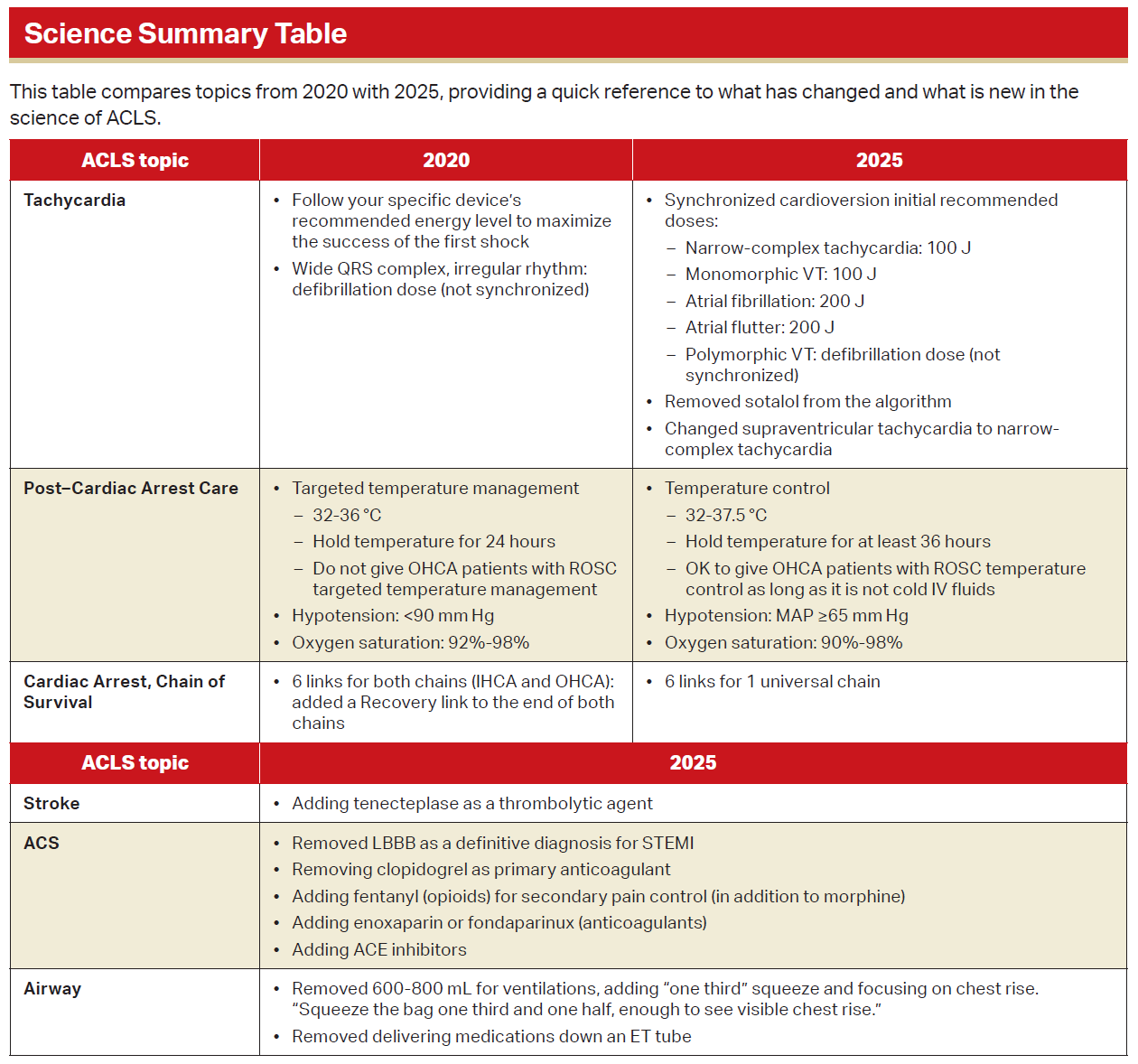
ACLS Academy strongly encourages students and practicing clinicians to keep this summary table accessible—it is the most practical way to stay aligned with the 2025 science. You can find it within the ACLS section of the AHA’s official guidelines here.
ACLS Academy Has Updated Its ACLS Courses
ACLS Academy is already teaching exclusively under the 2025 ACLS Guidelines. This includes:
Fully updated instructor certifications
Revised videos, manuals, and algorithm charts
New megacode scenarios aligned with the 2025 standards
Updated manikin programming and CPR quality feedback tools
A refreshed testing and skills evaluation process
Students who enroll now train with the final guidelines—not transitional or interim updates.
ACLS Academy’s updated ACLS course includes:
Realistic, scenario-based megacodes reflecting the 2025 algorithms
Hands-on practice integrating airway, rhythm management, and team roles
Updated testing materials based on the final AHA content
Clear guidance on team leadership and human factors
The newest pharmacology recommendations and decision trees
Reinforcement of high-quality CPR throughout every scenario
Classes are available in Quincy, Bridgewater, and Newton Center, with blended online + in-person formats for convenience.
Be Ready. Be Current. Be Confident.
The 2025 AHA ACLS Guidelines represent the newest and most refined approach to treating cardiac emergencies—and ACLS Academy is proud to be among the first to teach them fully and accurately in Massachusetts.
By training with instructors already certified in the updated science and using the AHA’s newest materials, you’ll gain the confidence, clarity, and competence needed to provide high-quality care in the most critical moments.
If you're ready to update your ACLS certification or learn the newest evidence-based standards, ACLS Academy is ready for you.
Register today and step into the future of lifesaving care with the 2025 ACLS Guidelines.