
Halloween has a soundtrack all its own. The opening notes of “Thriller” can fill a dance floor, while “Somebody’s Watching Me” instantly adds an eerie note to almost any gathering.
But some familiar Halloween songs may do more than set a spooky mood. Their steady rhythms can also help people remember the recommended pace for chest compressions during CPR.
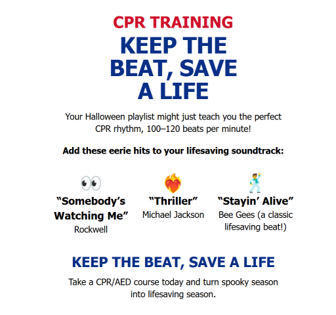
“Keep the Beat, Save a Life,” highlights songs that fall within the recommended range of 100 to 120 beats per minute. A familiar beat can serve as a mental metronome, helping a responder maintain the correct compression rate during a cardiac emergency.
The song may help you remember the rhythm. Knowing how and when to use it, however, comes from CPR training.
Why Compression Rhythm Matters: The Science of 100–120 BPM
During cardiac arrest, the heart suddenly stops pumping blood effectively. Without blood flow, the brain and other vital organs are deprived of oxygen.
Chest compressions help circulate oxygen-containing blood until emergency responders arrive or the heart’s rhythm can be restored. According to the American Heart Association, adult chest compressions should be performed at a rate of 100 to 120 per minute.
Too-slow compressions may not circulate enough blood. Going too fast can make it difficult to reach the proper depth or allow the chest to recoil fully between compressions.
Remembering a number in the middle of an emergency may be difficult. Remembering the beat of a song you have heard hundreds of times may be easier.
Top 5 Halloween Songs That Match the Ideal CPR Rhythm
There are several Halloween favorites that can help people remember the proper compression rate.
“Somebody’s Watching Me” by Rockwell
Few songs capture the feeling of being watched quite like this 1980s hit. Its steady beat also provides a memorable rhythm for CPR compressions.
“Thriller” by Michael Jackson
“Thriller” is one of the most recognizable Halloween songs ever recorded. Its beat falls within the recommended range for chest compressions, giving the Halloween classic an unexpected lifesaving connection.
“Stayin’ Alive” by the Bee Gees
Although it is not strictly a Halloween song, “Stayin’ Alive” may be the best-known CPR memory aid. Its rhythm is easy to recognize, and its title makes it especially difficult to forget.
There are a few more Halloween-friendly choices that fit the theme:
“Superstition” by Stevie Wonder
With a tempo of approximately 100 beats per minute, “Superstition” sits at the lower end of the recommended compression range. Its unmistakable opening riff makes it an easy song to recall under pressure.
“People Are Strange” by The Doors
At approximately 120 beats per minute, “People Are Strange” sits near the upper end of the recommended range. It is another seasonal favorite that can help provide a consistent pace.
Why Greater Boston Residents Need Hands-On CPR Practice
Keeping the beat is only one part of high-quality CPR.
Effective adult chest compressions also require:
Correct hand placement in the center of the chest
Adequate compression depth
Full chest recoil after each compression
Minimal interruptions
A firm, stable surface
Continued compressions until professional help arrives or the person shows signs of life
Hands-on CPR training allows you to feel how much force is needed and receive feedback about your rate, depth, hand position, and recoil.
Listening to “Thriller” may help you remember the pace. It cannot show you whether your compressions are deep enough or your hands are in the correct position.
Massachusetts CPR & AED Guidelines: Steps to Take in an Emergency
If a teen or adult suddenly collapses, the first priority is recognizing the emergency and taking action.
1. Check for Responsiveness and Normal Breathing
Tap the person and shout to see whether they respond. Look for normal breathing.
A person in cardiac arrest may gasp or make irregular breathing sounds. These agonal gasps are not normal breathing and should not delay CPR.
2. Call 911
Call 911 immediately or direct someone else to call. If you are alone and have a mobile phone, use the speaker setting so the dispatcher can provide instructions while you begin helping.
3. Send Someone to Find an AED
Ask a specific person to retrieve an automated external defibrillator if one is available. AEDs are commonly found in schools, workplaces, gyms, athletic facilities, community centers, and other public spaces.
4. Begin Hands-Only CPR
Place both hands in the center of the chest and push hard and fast. Use a familiar song between 100 and 120 beats per minute to help maintain your pace.
5. Use the AED as Soon as It Arrives
Turn on the AED and follow its spoken instructions. The device will explain where to place the pads, analyze the person’s heart rhythm, and advise a shock only when one is appropriate.
Continue CPR and follow the AED prompts until emergency responders take over or the person begins showing signs of life.
When to Use Hands-Only CPR vs. CPR With Rescue Breaths
Hands-Only CPR is recommended for a teen or adult who suddenly collapses.
In emergencies involving infants or children, drowning, choking, overdose, or a breathing-related collapse, CPR with breaths may be particularly important. Formal training prepares responders to adjust their technique for different ages and circumstances.
This is another reason a song alone is not enough. The rhythm may support your response, but training helps you understand what kind of response the situation requires.
Get Certified: Hands-On CPR & AED Training Across Massachusetts
Music is a powerful memory tool. A familiar song can stay with us for decades, often bringing back lyrics, emotions, and experiences after hearing only a few notes.
That same connection can make music useful during CPR. Remembering the beat of “Thriller,” “Stayin’ Alive,” “Superstition,” or “People Are Strange” may help you maintain an appropriate compression rate when stress makes it difficult to focus.
Training completes the lesson by teaching you how to:
Recognize cardiac arrest
Call for emergency assistance
Perform effective chest compressions
Provide breaths when appropriate
Use an AED
Respond to adults, children, and infants
Continue care until professional help arrives
ACLS Academy offers Heartsaver® CPR and AED training for community members, caregivers, teachers, coaches, and workplace teams. BLS courses provide healthcare professionals and students with hands-on instruction in high-quality CPR, ventilation, AED use, and team response. Advanced courses such as ACLS and PALS prepare healthcare providers to manage complex adult and pediatric emergencies.
Register for CPR Classes in Quincy, Bridgewater, or Newton Center Today
Go ahead and add a few lifesaving beats to your Halloween playlist. More importantly, take the next step and learn the skills behind the rhythm.
The song may help you keep the beat. CPR and AED training can help you recognize when to begin, perform effective compressions, and know what to do next.
Register for a CPR, AED, BLS, ACLS, or PALS course with ACLS Academy.
Learn More
Continue building your CPR knowledge with these additional resources from ACLS Academy.
Saving Lives: 4-Year-Olds and Taylor Swift
Discover how children can begin learning emergency-response skills and explore more popular songs with tempos that match the recommended CPR compression rate.
Fact or Fiction: Can You Spot the CPR Myths?
Test your knowledge and uncover common misconceptions that could affect how someone responds during a cardiac emergency.
Sudden Cardiac Arrest Awareness Month: Would You Know What to Do?
Learn how to recognize sudden cardiac arrest, begin CPR, locate and use an AED, and provide critical help while emergency responders are on the way.
ACLS Academy is an American Heart Association Training Center offering high-quality emergency-response and healthcare certification courses in Quincy, Bridgewater, and Newton Center, Massachusetts. Guided by our “For Providers, by Providers” philosophy, ACLS Academy offers Heartsaver CPR and AED, First Aid, BLS, ACLS, ACLS EP, PALS, PALS Plus, PEARS, ASLS, NRP, TNCC, ENPC, Stop the Bleed, Bloodborne Pathogens, Fetal Heart Monitoring, and AHA instructor training. Group, corporate, and on-site courses are also available for workplaces, schools, healthcare organizations, and community groups.